

Computational modelling
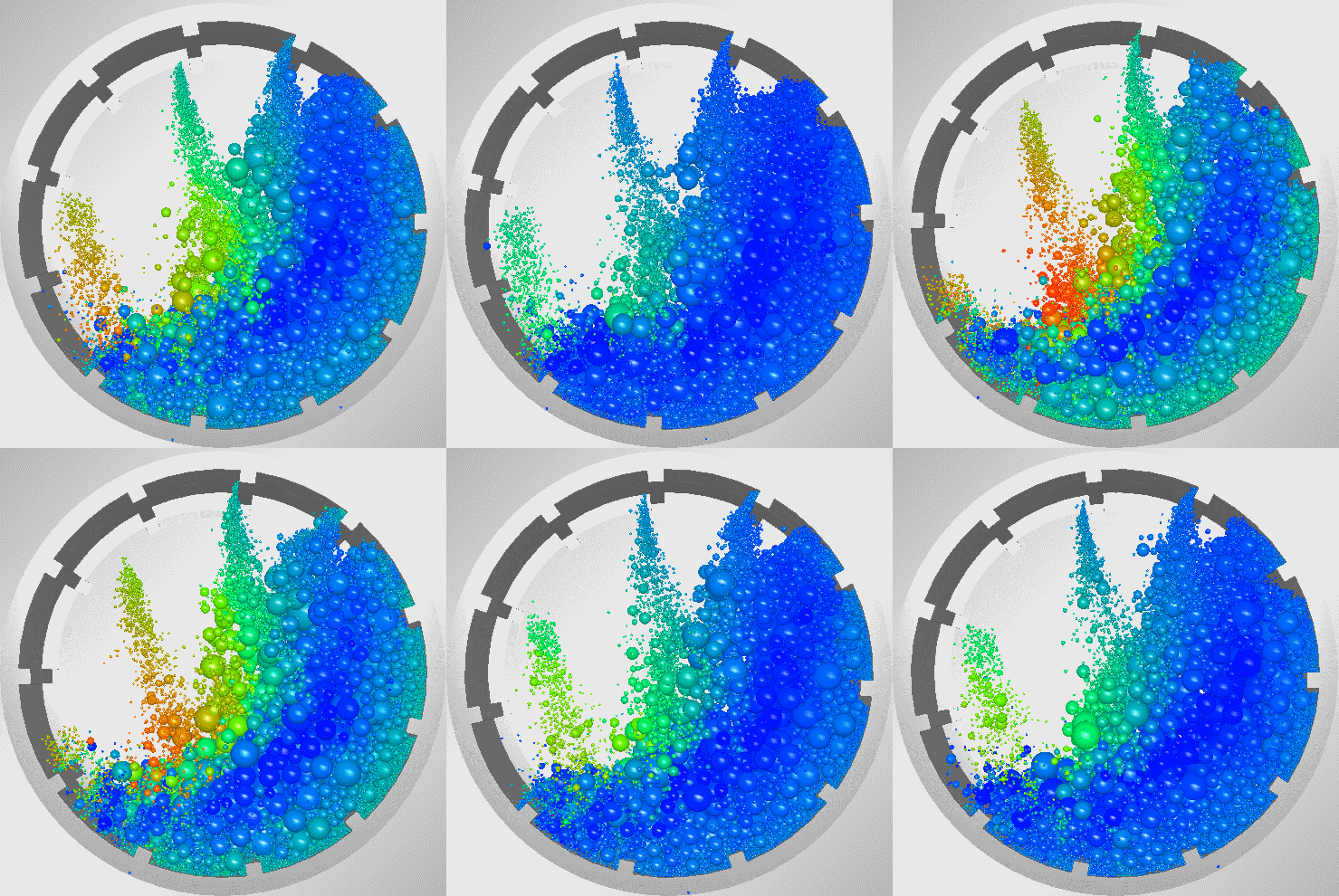
A wide range of industrial systems depict behaviour at the length scale of interest that is dominated by interactions of discrete material regions.
The major advantage of the computational frameworks like the Discrete element method (DEM) and Computational fluid dynamics (CFD) is the ability to approximate the mechanical environment with the potential to discern meaningful in-situ measurements and behaviour.
Numerical simulation is employed in a complimentary manner with other in-situ measurement tools like Positron emission particle tracking (PEPT) and X-ray imaging.
Validation
The computational demands and lack of sound experimental verification have limited the value of DEM and CFD techniques in many industries. This work seeks to fill the vital gap linking computational results to rigorous experimental data. It is only with validation that any confidence can be given to the predictive capability of such computational tools, especially when the predictive range lies outside the range over which the existing semi-empirical models were developed and tested. In-situ measurement tools like Positron emission particle tracking (PEPT) and X-ray imaging allow, for the first time, a detailed investigation into aspects such as contact models, energy distributions and flow.
Radiation Transport
In-situ measurement techniques like PEPT are based on the principle of positron annihilation. Simultaneous detection of the two gamma rays in an array of detectors (a PET “camera”) defines a line along which the annihilation between positron and an electron occurred. Detection of a few such events in a very short time interval allows the position of the tracer particle to be triangulated in three dimensions. Location in space of the tracer particle depends on the speed and activity of the tracer particle, and the attenuating environment that defines the system under study. Complex environments with high speed tracers can lead to unpredictable transport of the resulting gamma rays. To better understand radiation transport in such scenarios computational modelling via monte carlo simulation of the decay and transport process is studied.
Collaborators
Much of the DEM and CFD research has been focussed on mineral systems like tumbling mills. The Centre for minerals research (CMR) housed in the department of chemical engineering at UCT is a key collaborator in this work.