

Positron Emission particle tracking

Figure 1: Typical outputs derived from PEPT imaging: (a) Solids fraction. (b) Mill within field of view of parallel plane pept camera. (c) Velocity field.
Positron Emission Particle Tracking (PEPT) is a non-invasive 3D imaging technique that tracks the motion of a representative grain (the tracer) that has been radio-labelled with a positron emitting radionuclide and allowed to move within the field of view (FoV) of a modified Positron Emission Tomography (PET) scanner.
Decay by β+ emission is quickly followed by annihilation with an electron, producing a pair of 511 KeV back-to-back gamma rays that define a line of response (LoR) passing through (or very close to) the tracer. A chronological series of coordinate pairs mostly corresponding to the endpoints of the LoRs constitutes the raw data. A selection of LoRs are then triangulated into grain coordinates (xp, yp, zp, tp) and constitute the measured data for studying granular flow.
Figure (1b) is a 2D illustration of the types of LoRs typically encountered. The spurious LoRs (reddish coloured lines) are removed using an iterative algorithm resulting in a redundant set of 3D lines (blue lines) whose intersection, in the least squares sense, defines the best estimate of the tracers position during the chosen time interval.
Typically, the 3D spatial coordinates of the tracer are accurate to within a millimeter at a temporal resolution of a few milliseconds. Figures (1a) & (1c) show typical PEPT results for the solids fraction distribution and velocity field of a granular binary mixture flowing in a tumbling mill operating in the catracting mode. The radial baffles or lifter bars are meant to facilitate the cataracting and increases the effective friction between the particles and the azimuthal wall.
iThemba LABS
The “EXACT3D” (Model: CTI/Siemens 966) PET scanner shown in figure 2 was designed with the aim of achieving high sensitivity and resolution using state-of-the-art detectors. The device consists of 36 detector buckets (cylindrical panels demarcated by dashed lines in figure 2a). Each bucket comprises 12 blocks with 64 standard bismuth germinate detector elements per block. The effective usable volume is a ring diameter ~50 cm and an axial FoV ~23 cm. The I/O and computing hardware can maintain a sustained acquisition rate of up to four million coincidence events per second. The scanner has been used for clinical research at Hammersmith Hospital, London since 1995, and may still be the most sensitive PET scanner in operation today. It is presently housed at the positron imaging facility, PEPT Cape Town, which is located at the South African national accelerator center, iThemba Laboratory for Accelerator Based Science (iThemba LABS).
The ring configuration facilitates the study of cylindrically symmetric flows. Typical LoRs for the ring scanner are also shown in figure 2 (red lines denote spurious LoRs). PEPT is currently the only non-invasive technique capable of mapping the in-situ flow fields in robust, industrial systems to the level of detail that is demanded for mechanistic modelling. Advances in computing have made numerical modelling of complex flows conceivable. However, realistic simulation of industrial systems is still decades away from being achieved. Consequently, most numerical modelling work still employs simplifying assumptions that ultimately make the computing tasks tractable. The integrity of these assumptions requires validation if they are to gain confidence within industry. PEPT offers detailed validation of the flow field and related parameters.

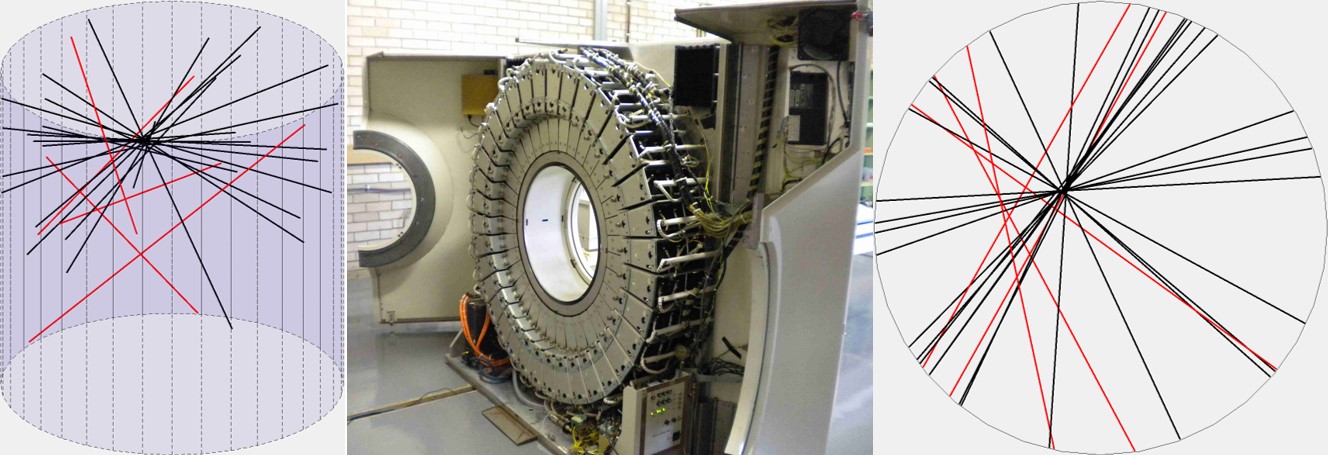
Figure 2: The exact 3D ring scanner. The left and right images are typical LoRs gathered over a few milliseconds.
The Positron Emission Particle Tracking laboratory at iThemba LABS cyclotron centre was opened in August 2009. The PEPT laboratory at iThemba LABS has all the obvious advantages with respect to radiation handling and licensing, and is available for research use by local and international scientists. PEPT experiments require positron-emitting radioisotopes which are produced by cyclotron proton beams. iThemba LABS routinely produces radioisotopes such as F-18 and Ga-68 for medical PET use.